Friday, 14 December 2012

AS ICT Unit 2 - Living in the Digital World

9. ICT Systems and their Components

10. Data & Information

11. People & ICT Systems

12. Transfer of Data in ICT

13. Safety & Security of ICT Systems

14. Procedures for Backup & Recovery

15. Uses of ICT Systems

16. Factors & Consequences of ICT

Thursday, 29 November 2012

2-14 Data Loss WebQuest

The Scenario
Name of the organisation
Mukilteo City Council

Type of organisation, for example, public company, government organisation, public utility

Government Organisation (Council)
What happened?
All of the city’s important data and computer information is wiped out.

What caused the incident?


A server failure as Dave Varga, Mukilteo's information technology director, left his office station in order to work on a fibre-optic line.
How did it affect the organisation?
All of the city’s data referring to planning and financial documents, ordinances, resolutions and city council meeting minutes was lost. Meaning city control was at a standstill.

How did it affect their customers/clients?
As the loss was for only a week,  there was little effect to the public of Mukilteo, and the council was able to resume as normal.

Was data lost?
100% of data was lost.

How did the organisation overcome the problem?
The city paid $36,000 to a Minnesota firm to retrieve the data, and about 95 percent of it was recovered.  The City Council plans on spending about $180,000 for an entirely new system, to prevent a similar system failure.

Was there anything else the organisation could do?
To prevent the same loss happening, large amounts of often backups should be created and stored in a safe location e.g. safe.

Monday, 26 November 2012

2-14 Backup and Recovery

A backup is simply an extra copy of data. So if data becomes corrupt or lost/stolen, it can be recovered.

A backup a recovery strategy is vital within any organisation.

Companies that have large data loss, 6% survive

Data could be:
        - Stolen 6%
        - Lost to diasaster 2%
        - Human error 32%
        - Hardware + Software error 38%

Backup media (storage)
        - USB Stick
        - CD and DVD
        - External Hard Drive

Organisations commonly backup to large hard drives in another remote location.

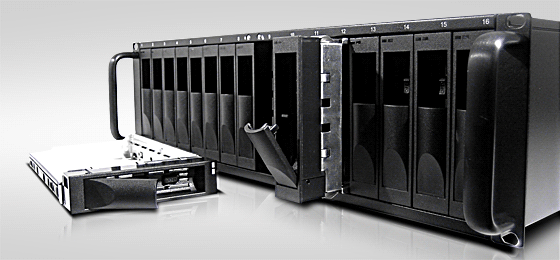
RAID Systems - instant backups in real time. Basically a massive amount of cheap hard drives that instantly copy the data.


DAT tapes - Removable media with a large capacity. Now surpassed by hard drives


Cloud - Remote backing up of data via the internet. The cloud is a concept and made up of various hard drives across the globe Eg. a word document sent to your own e-mail is store in the "cloud"; accessable from anywhere in the world. If you deleted it from all computers, it would still be avaliable from the internet


________________________________________________________________________

Backup Strategy

What files should be backed up?
Who is resposible?
When will the backups be done?
Where will the backups be kept?
Which backupmedia will be used?

Recovery Strategy

What files, OS and software/applications will need to be recovered?
Who is resposible?
When will the deadlines for recovery be?
Where are recovery offices and computer equiptment
How will we ensure continuity of service


Types of Backup
Type of Backup
Time to Backup
Full Restoration Time
Storage Space
Full – All data is backed up.
A long time as all data is saved.
Very fast as a full restore is complete in one go.
Very large size commonly stored on a removable hard drive.
Differential – Data that has changed since the last full backup.
A medium amount of time as a large group of data is saved.
A medium amount of time as a full restoration would be done in a few large chucks.
A medium size stored either on a large memory stick or a DVD
Incremental – Data that has changed since any other backup.
A short amount of time as small files and documents are saved.
A very long time as a full restoration would be done in very small amounts at a time.
The smallest with only a few files on a small USB stick

Monday, 12 November 2012

2-13 Threats to ICT Systems


Threats to ICT Systems

Disgruntled Employees: Employees who might be having a bad day might feel inclined to mess with their company's files, this is a serious threat. Same for employees resigned, fired or retired, they will need their access removed.

This can be prevented with controlled procedures prevent access to these employees or ex-employees.

Example: In some establishments, an employee who has been sacked would be escorted by security to avoid them access files.


Untrained Staff: Staff who have not been sufficuently trained might have the pontential to overwrite, change or delete important files.


This can be prevented with sufficient training including additional training with more up-to-date software and programs.

Example: A new employee carries out his work as instructed but when he save, he overwrites exsisting files.

Viruses: Small programs which can be insterted into computer systems designed to carry out destruction tasks such as deleting, changing or freezing files and software. 

These can be avoided by installing an Anti-virus software package. Subscription packages are best as they update alongside new viruses.

Example: An employee brings in a memory stick which contains a virus designed to delete data. This enters the company's system and every computer is infected.


Spyware: Remote software which accesses a computer, monitoring all of the actions carried out by that computer (Spying)

This can be prevented by using an Anti-virus software package. These packages handle both Viruses and spyware.

Example: Software log all key strokes entered into a computer. This then displays and user id s and passwords, with the website or files they were used.


Hackers: People who gain unauthorised access to computers remotely, Altering and deleteing files and viewing privates items.

Preventable with user IDs and passwords, making the hackers task much harder and near impossible without expert tools.

Example: Someone could "hack" into a companys income to see where their business comes from and take advantage of this information for their own company.

Sunday, 11 November 2012

Computer Misuse Research Task

Gerald Wandra - US
Unauthorized access to computers at the Sloan-Kettering Cancer Centre in New York and a Los Angeles bank.

Two years probation.

Chad Davis - US
Intentionally hacking a protected computer and wilfully causing damage.

Six months in prison, US$8,054 in restitution and three years probation

Robert Tappan Morris - US
Intentional access of federal interest computers without authorization thereby preventing authorized access and causing a loss in excess of US$1,000

Three years probation and 400 hours of community service.

Monday, 5 November 2012

2-13 Computer Misuse Act 1990


Computer Misuse Act (1990)
     An Act to make provision for securing computer material against unauthorised access or modification; and for connected purposes.

        Offences:

- Unauthorised access to material | Max. 6 months imprisonment and/or £5000 fine.
        Example: An employee accessing a companies database to view their colleages' pay.

- Unauthorised access with intent | Max. 5 years imprisonment and/or unlimited fine.
        Example: A person hacks into their own back account details intending to change their balance.

- Unauthorised modification | Max. 5 years imprisonment and/or unlimited fine.
        Example: A hacker vandilises a website from another computer.


Thursday, 25 October 2012

2-12 Peer-to-peer


Peer-to-peer

       A peer-to-peer network is any network which doesn't use a server. 


       Usually from 2 to 5 computer, otherwise the network will become too slow to use without a central server.

       They are self-installed most commonly for domestic use, to share files and peripherals such as printers, however some small business use them as they are much cheaper than client-server networks.

        The most popular way of setuping up a peer-to-peer network is to have a few computer connected through a hub (a non-intelligent switch)

Saturday, 20 October 2012

2-11 People and ICT Systems

people in ICT systems

end user - the person who uses the systems/people that use ict to help them with their work
example : teacher / air traffic controller

end users will mostly use general purpose software: e.g word and excel. Designed to be easy access and comfortible to use by lots of people in a wide array of jobs


ICT professionals: P
eople working in ICT generally have ICT qualifications such as degrees or other technical qualifications. e.g server analyst, does server maintenance.  systems analyst, works with a client to analyse their requirements and to design a suitable ICT system.

Computer programmers converts the design specifications into a computer code using a programming language such as C++

ICT help-desk technicians provide solutions to end users in respect of day computer problems.

Web managers oversee the work of webmasters and web developers in a large organisation.
ICT proffesionals with mostly used special purpose software: e.g air traffic control. designed for a specific job.


characteristics of users of ICT

Experience                           inexperienced - windows
                                                experienced users - programming language
 
Age                                         young - big buttons, fun pictures, simple language
                                                old - clear large text, appropriate language

Physical characteristics   disabilities (wheel chairs, sight, hearing)

environment of use            hazardous, mobile devices, office environment


skills for ICT professionals

problem solving skills       programmer -IT technician -systems analyst

flexible working hours      systems installers

team working skills            (The above)

communication skills        oral comms -written comms

Thursday, 18 October 2012

2-10.2 Coding and encoding

Encoding

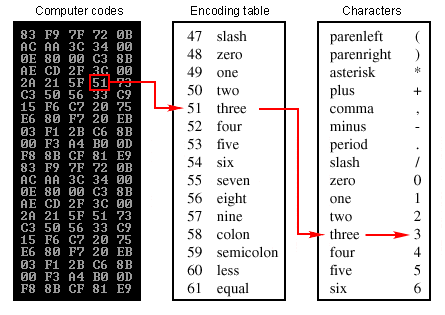
When data is collected, to simplify, it will most probably need to be encoded. Encoding is tranfering the data into a form which computers understand; usually binary. 

Without encoding we would not be able to use computers effectively as most, if not all, can't quite remember every byte that makes every letter, number, pixel sound wave etc. 


Coding

data is usually coded before encoding to make the processing much fast and effective. Data is coded to to keep entrys short, saving space and time Eg M = male, F = female


2-10.1 Data and Information

What is data?

Data is raw facts and figures or a set of values.

A set of data might consist of 2, 4, 3, 5, 6 or 23, 45, 67, 98, 78

Types of data

Data can be part of many formats; Text, numbers, pictures, video and sound.

Bits and Bytes

Computers store every type of data in Binary (011010100110)

A single unit of binary is called a "bit" (either a 0 or a 1)

One byte is made of 8 bits and this one byte can store one letter, number, pixel in a bitmap image, or fragment of sound. For example "A" is represented by 01000001.

Each square is one byte

Monday, 17 September 2012

2-9.2 What is a System?


In it's most basic form, a system requires input, processing and output

A example of an old manual system would be a library's card index system:

        - A card index is used so that books can be organised by author, title or genre. This was found a problem as with many books, locating a single book was often difficult or simply too slow. Also most books aren't obviously titled such as "Twelfth night" wouldn't obviously relate to a "fatal love triangle."


        - This method was then substituted by a computer where search was enabled, so it was quick and easy to browse an entire database, finding a single or group of similar books in a matter of nanoseconds.


Input-process-output


The stages of Input, process and output form the basic functions fo a computer system.

Input - Data is entered via an input device, such as a keyboard

Process - Calculations, queries and other operations are performed on the data

Output - The results of the processing are sent to an output device sush as a monitor

Example: 
1. Photographs from digital camera
2. Crop, airbrush defects, reduce resolution and change size in a graphics package
3. Improved photographs to be displayed on page

2-9.1 What is ICT?


- ICT (Information Communications Technology) is how people use technology to input, process, store and transfer data in order to get an output of information.


This can be anything from producing a spreadsheet for an upcoming business meeting to editing a photo of last night, from bank transfers to changing the channel on your T.V. They all require, input, processing, and output.