Thursday, 25 October 2012

2-12 Peer-to-peer


Peer-to-peer

       A peer-to-peer network is any network which doesn't use a server. 


       Usually from 2 to 5 computer, otherwise the network will become too slow to use without a central server.

       They are self-installed most commonly for domestic use, to share files and peripherals such as printers, however some small business use them as they are much cheaper than client-server networks.

        The most popular way of setuping up a peer-to-peer network is to have a few computer connected through a hub (a non-intelligent switch)

Saturday, 20 October 2012

2-11 People and ICT Systems

people in ICT systems

end user - the person who uses the systems/people that use ict to help them with their work
example : teacher / air traffic controller

end users will mostly use general purpose software: e.g word and excel. Designed to be easy access and comfortible to use by lots of people in a wide array of jobs


ICT professionals: P
eople working in ICT generally have ICT qualifications such as degrees or other technical qualifications. e.g server analyst, does server maintenance.  systems analyst, works with a client to analyse their requirements and to design a suitable ICT system.

Computer programmers converts the design specifications into a computer code using a programming language such as C++

ICT help-desk technicians provide solutions to end users in respect of day computer problems.

Web managers oversee the work of webmasters and web developers in a large organisation.
ICT proffesionals with mostly used special purpose software: e.g air traffic control. designed for a specific job.


characteristics of users of ICT

Experience                           inexperienced - windows
                                                experienced users - programming language
 
Age                                         young - big buttons, fun pictures, simple language
                                                old - clear large text, appropriate language

Physical characteristics   disabilities (wheel chairs, sight, hearing)

environment of use            hazardous, mobile devices, office environment


skills for ICT professionals

problem solving skills       programmer -IT technician -systems analyst

flexible working hours      systems installers

team working skills            (The above)

communication skills        oral comms -written comms

Thursday, 18 October 2012

2-10.2 Coding and encoding

Encoding

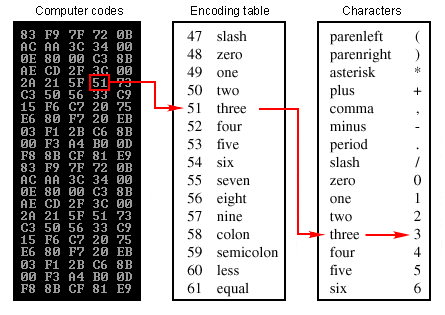
When data is collected, to simplify, it will most probably need to be encoded. Encoding is tranfering the data into a form which computers understand; usually binary. 

Without encoding we would not be able to use computers effectively as most, if not all, can't quite remember every byte that makes every letter, number, pixel sound wave etc. 


Coding

data is usually coded before encoding to make the processing much fast and effective. Data is coded to to keep entrys short, saving space and time Eg M = male, F = female


2-10.1 Data and Information

What is data?

Data is raw facts and figures or a set of values.

A set of data might consist of 2, 4, 3, 5, 6 or 23, 45, 67, 98, 78

Types of data

Data can be part of many formats; Text, numbers, pictures, video and sound.

Bits and Bytes

Computers store every type of data in Binary (011010100110)

A single unit of binary is called a "bit" (either a 0 or a 1)

One byte is made of 8 bits and this one byte can store one letter, number, pixel in a bitmap image, or fragment of sound. For example "A" is represented by 01000001.

Each square is one byte